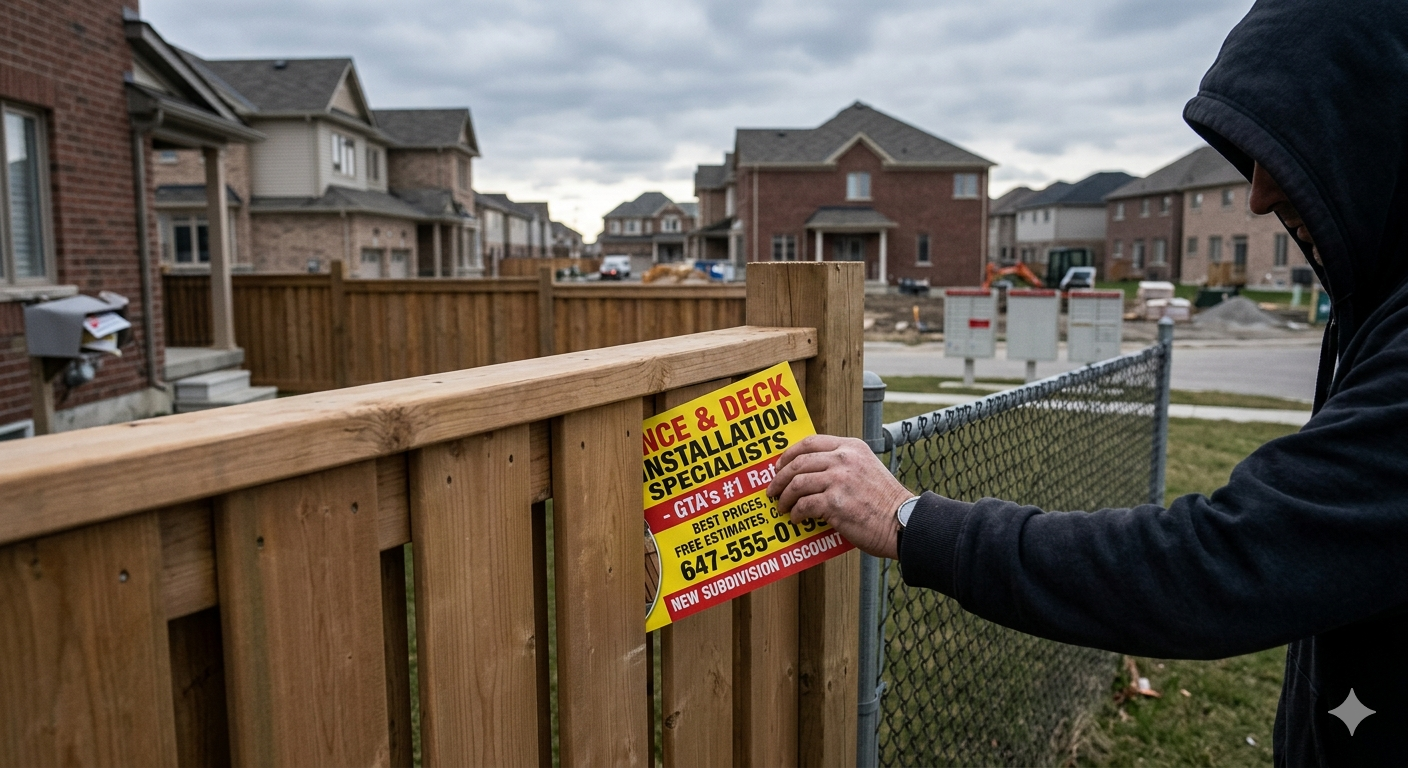
The "Flyer in the Mailbox" Fence Scam Hitting New GTA Subdivisions
A coordinated fence‑building scam is sweeping new GTA subdivisions, targeting homeowners in Vaughan, Brampton, Milton, Whitby, and East Gwillimbury. Known as the “Toss‑Over‑The‑Fence” scam, predatory contractors drop lowball flyers, claim they’re already hired by your neighbors, and demand a 50% cash deposit before disappearing or abandoning the job. Others exploit a hidden “soil complication” clause to legally keep your deposit after digging a single post hole. Homeowners can protect themselves by verifying WSIB coverage, insisting on Ontario One Call locates, and avoiding contractors with no physical business address. The safest approach is coordinating a multi‑neighbor fence build with a fully insured, established company instead of responding to mailbox flyers.
The "Flyer in the Mailbox" Fence Scam Hitting New GTA Subdivisions
A highly coordinated home improvement scam is aggressively targeting new subdivisions across the GTA. Homeowners in rapidly expanding communities across Vaughan, Brampton, Milton, Whitby, and East Gwillimbury are reporting a major spike in high-pressure door-to-door and mailbox solicitation from predatory, fly-by-night fence and deck builders.
Dubbed the "Toss-Over-The-Fence" scam, these operators exploit a unique structural vulnerability: brand-new housing developments where hundreds of properties urgently need shared boundary lines fenced at the exact same time.
If you recently moved into a new GTA subdivision, here is exactly how this predatory scheme functions, the legal loopholes these contractors exploit, and how to protect your property and wallet.
How the "Toss-Over-The-Fence" Scheme Works
The scam plays out through a highly calculated, psychological formula designed to create a false sense of urgency and community consensus.
[SCAMMER DROPS LOWBALL FLYER] → Claims: "I'm already doing your neighbor's yard"
→ Demands: 50% "Cash-Only" Deposit for materials
→ RESULT: Crew vanishes mid-job or drops legal lines
The Hyper-Local Bait: A representative drops an unbranded flyer into your mailbox or over your temporary backyard silt fence. The flyer quotes an impossibly low rate—typically $35 to $45 per linear foot for standard 6x6 pressure-treated wood, far below actual 2026 GTA material and labor averages.
The Manufactured Consensus: The salesperson knocks on your door and claims, "I'm already building the fence for your rear neighbor and your left-side neighbor next week. If you sign right now, I can wrap your yard into the batch and save you thousands." In reality, they have not signed contracts with any of your neighbors.
The Cash Deposit Disappearance: They demand an immediate 50% deposit via cash or e-Transfer to "secure lumber pricing before it spikes." Once the money clears, the crew either vanishes or drops off a single load of warped lumber, digs a few uneven post holes, and abandons the site.
The Legal Loophole: The "Soil Complication" Clause
For scammers who do not disappear entirely, the real trap lies in their one-page, fine-print contracts.
Most predatory operators include a vague "Sub-Surface Obstruction" or "Soil Complication" clause.
Once they dig the first post hole and inevitably hit dense Halton Till clay or buried construction debris—common in new GTA subdivisions—they immediately halt construction. They then demand an extra $150 to $300 per post hole to continue drilling.
If you refuse to pay this surcharge, they walk away, legally keeping your 50% deposit because they technically "commenced structural work."
3 Red Flags of a Predatory GTA Fence Contractor
To protect yourself and your neighbors from financial loss, verify every inbound contractor against these three non-negotiable baselines:
Red Flag 1: No Valid WSIB Clearance Certificate
Any legitimate fencing crew must carry active WSIB coverage. If an uninsured worker is injured or strikes a buried gas line, you can be held personally liable. Always demand a current WSIB clearance number.
Red Flag 2: Refusal to Coordinate with Ontario One Call
It is a strict legal requirement to secure a utility locate before digging. If a contractor says, "We don't need to call, we know where the lines are," turn them away immediately. Striking a buried gas or fiber line can result in catastrophic damage and massive fines.
Red Flag 3: No Business Address or Local Office
If their quote sheet lists only a first name, a burner cellphone, and a Gmail address—with no physical office or verified Google Business Profile—you are dealing with an untraceable operator.
The Safe Path: Coordinating Multi-Neighbor Builds
Fencing a new subdivision does not have to be a gamble. The safest and most cost-effective approach is to bypass mailbox flyers entirely and establish a structured Neighborhood Fence Committee.
Gather your adjacent neighbors to collectively review and hire a single, fully insured enterprise. This pooled purchasing power naturally drives down the price per linear foot without sacrificing structural integrity.
Ready to find an established, legally insured crew for your street? Review our vetted directory of the Best Fence and Deck Builders in the GTA or read our complete 2026 Residential Fencing Cost & Material Guide before handing over a single dollar.