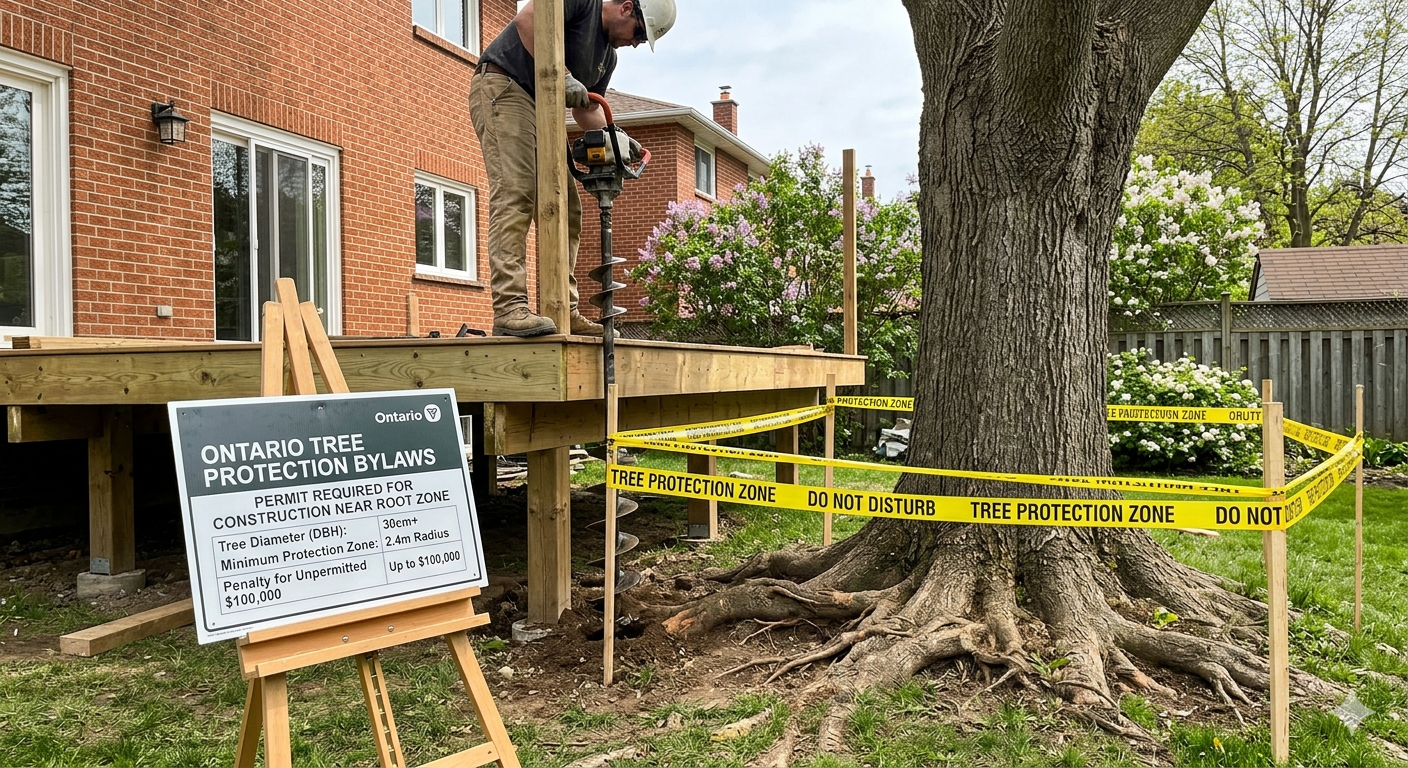
Ontario Tree Protection Bylaws: When You Need a Permit to Build a Deck or Patio Near a Root Zone
Many GTA homeowners don’t realize that building a deck or patio near a mature tree can violate municipal tree protection bylaws. Digging post holes or altering soil inside a Tree Protection Zone can legally count as “tree injury,” leading to construction stops and fines up to $100,000. Knowing your tree’s DBH, the TPZ radius, and when a permit is required is essential before starting any outdoor project.
Ontario Tree Protection Bylaws: When You Need a Permit to Build a Deck or Patio Near a Root Zone
Many Greater Toronto Area (GTA) homeowners assume that because a deck is low to the ground or built on private property, they have full freedom over placement. In reality, building a deck or patio near mature trees without a permit can violate municipal tree protection bylaws, triggering automatic construction stops and fines ranging from $500 to $100,000 per tree.
A tree’s critical root system often extends far beyond its visible canopy. Common deck construction activities—digging post holes, pouring concrete, or altering soil levels—can legally “injure” a protected tree.
1. Legal Thresholds Across the GTA
Most Ontario municipalities protect trees based on their Diameter at Breast Height (DBH), measured 1.4 metres (4.5 feet) above ground. If a tree on your property—or your neighbour’s—meets these thresholds, it is legally protected:
https://www.toronto.ca/services-payments/building-construction/tree-ravine-protection-permits/- City of Toronto: Protects all private trees with a DBH of 30 cm or greater. (City is exploring lowering this limit.)
- City of Vaughan: Protects trees with a DBH of 20 cm or greater, or if more than three trees between 20–30 cm are removed in a year.
- Town of Newmarket: Requires permits for any structural work impacting mature private trees.
- Ravine & Special Zones: In designated ravine or natural feature protection areas, all trees are protected regardless of size. No digging is allowed without a ravine permit.
2. Understanding the Tree Protection Zone (TPZ)
A Tree Protection Zone (TPZ) is a mandatory barrier that shields a tree’s root system during construction. Inside a TPZ, the following activities are prohibited:
- Digging, trenching, or excavating
- Changing soil grade or adding fill
- Storing lumber, gravel, or building materials
- Dumping liquids such as concrete slurry or wash water
TPZ size increases with tree diameter. Toronto’s standards:
| Tree Diameter (DBH) | Minimum TPZ Radius |
|---|---|
| Less than 10 cm | 1.2 metres |
| 10 to 40 cm | 2.4 metres |
| 41 to 50 cm | 3.0 metres |
| 51 to 60 cm | 3.6 metres |
| 61 to 70 cm | 4.2 metres |
Boundary Rule: If a protected tree is on your neighbour’s property but its TPZ extends into your yard, you cannot build within that zone without a permit.
3. How Deck Construction Damages Roots
Post-Hole Excavation (Physical Injury)
About 90% of a tree’s absorbing roots live within the top 60 cm of soil. A standard 1.2‑metre deck footing cuts directly through these roots. Severing even one major lateral root can destabilize the tree and kill a large portion of its canopy.
Grade Alterations & Patios (Suffocation)
Roots need oxygen. Stone or concrete patios seal the soil surface, blocking oxygen and water. Adding or removing soil also suffocates roots by altering natural grade levels.
4. The Permit Process for “Tree Injury”
If your deck design requires building inside a protected root zone, you must obtain a Permit to Injure a Tree before your building permit can be approved.
- Hire a Certified Arborist: An ISA or ASCA-certified arborist assesses tree health and construction impact.
- Create a Tree Protection Plan: Includes tree locations, deck footing layout, TPZ boundaries, and hoarding placement.
- Submit the Application: Submit arborist report + scaled site plans to Urban Forestry. Processing typically takes 30+ business days.
- Install Tree Hoarding: Plywood or chain-link fencing must be installed around the approved TPZ before the permit is issued.
5. Smart Design Workarounds
You can often avoid the permit process by adjusting your deck engineering:
- Cantilevered Joists: Place footings outside the TPZ and cantilever joists over the root zone.
- Helical Piles / Diamond Piers: These foundations displace minimal soil and can slip between roots.
- Hand-Digging or Hydro-Vac: Exploratory digging can confirm whether major roots are present. If none over 5 cm are found, the city may allow the footing.
Suggested Citation Format
GTA Trades Daily Editorial Team. (2026). Ontario Tree Protection Bylaws: When You Need a Permit to Build a Deck or Patio Near a Root Zone. GTA Trades Daily Articles & Guides.
Planning a Deck or Patio?
If you're drafting plans, tell us:
- The approximate diameter of the largest nearby tree
- Whether your property falls under Ravine Protection or a Conservation Authority
We can point you to the exact municipal forms and certified arborists you’ll need.